Benchmarks
A reproducible comparison against netCDF4 and Zarr v3 lives in
atlas-python/benchmarks/.
The harness writes the same deterministic data through each backend,
then measures write time, slice-read time, and on-disk size. Each backend
uses its canonical "many datasets" layout:
- atlas — one store with N datasets.
- netcdf+dask — N separate
.ncfiles, read viaxr.open_mfdataset(parallel=True, ...).isel(...).load(). Dask threaded scheduler under the hood — the canonical xarray-on-netCDF pattern. - zarr+dask — N separate
.zarrstores, also viaopen_mfdataset— the canonical xarray-on-zarr pattern.
For atlas the sweep shows two rows — the two parallel paths people actually reach for:
- atlas+dask —
view.read_arrays(...)wrapped indask.delayedacross datasets (opt in with--use-dask). - atlas-bulk —
Atlas.read_array_across_stacked(...): one PyO3 call per variable, parallelised in Rust on the tokio runtime, returns eager numpy (opt in with--atlas-bulk).
The default (serial) atlas read path — iterate
view.open_as_xarray_dataset(name).isel(...).load() — isn't in the chart; it scales
linearly with N and is fine for small fleets, but at the scales below
(100+ datasets) you should already be reaching for one of the parallel
paths. --netcdf-groups / --zarr-groups add layouts that use one file
with N internal groups, and --netcdf-no-dask / --zarr-no-dask add
serial-loop variants of the netcdf and zarr reads — useful for isolating
dask's contribution to those paths, but not part of the default sweep.
Sweep results
Each chart sweeps datasets ∈ {100, 500, 1000} for one case at a fixed
variable count, run on a typical Apple Silicon laptop. Bars are grouped
by dataset count and color-coded per backend: orange = netcdf+dask,
red = zarr+dask, purple = atlas+dask, teal = atlas-bulk.
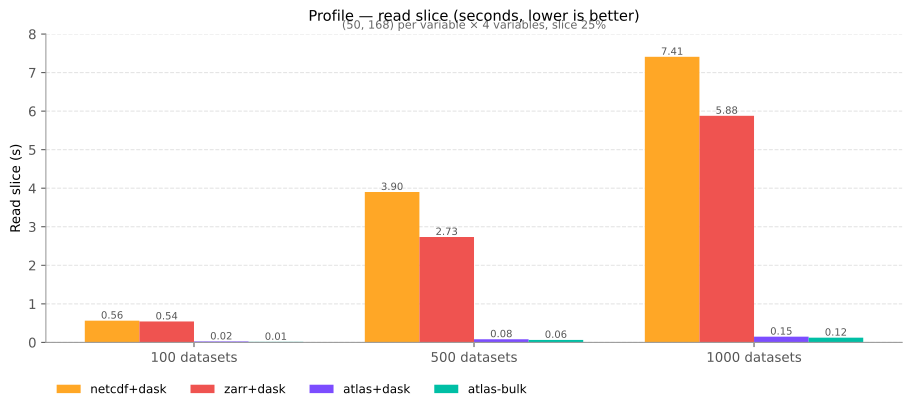
--case profile (4 variables)
(50, 168) per variable × 4 variables, slice 25%. Overhead-dominated; the
per-dataset work is small enough that file-open / metadata cost dominates
the read path for netCDF and zarr.
| Datasets | netcdf+dask (s) | zarr+dask (s) | atlas+dask (s) | atlas-bulk (s) |
|---|---|---|---|---|
| 100 | 0.564 | 0.543 | 0.023 | 0.013 |
| 500 | 3.901 | 2.734 | 0.081 | 0.064 |
| 1000 | 7.409 | 5.879 | 0.148 | 0.122 |
atlas-bulk at 0.12 s wins by ~48× over zarr+dask at 1000 datasets,
and the gap widens with N because per-dataset open cost compounds for
the netcdf/zarr paths. atlas+dask lands within ~20% of atlas-bulk —
per-dataset overhead is already tiny here, so the extra fan-out from
dask.delayed mostly just amortises the Python loop.
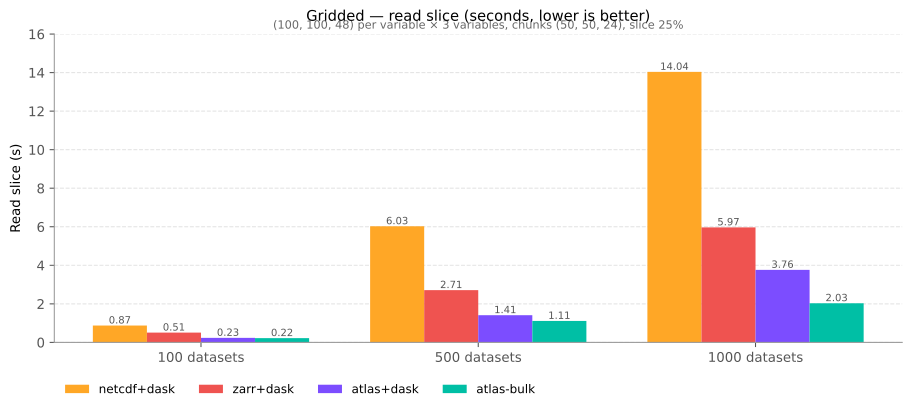
--case gridded (3 variables)
(100, 100, 48) per variable × 3 variables, chunks (50, 50, 24), slice
25%. Decompression-dominated; all three backends push the slice down to
chunk-level reads.
| Datasets | netcdf+dask (s) | zarr+dask (s) | atlas+dask (s) | atlas-bulk (s) |
|---|---|---|---|---|
| 100 | 0.873 | 0.506 | 0.233 | 0.220 |
| 500 | 6.025 | 2.711 | 1.410 | 1.114 |
| 1000 | 14.037 | 5.968 | 3.763 | 2.031 |
atlas-bulk is the only path whose lead grows with N — at 1000 datasets
it's 2.9× faster than zarr+dask and 6.9× faster than netcdf+dask
on slice reads. atlas + --use-dask is the right pick when you need
dask-graph composability (downstream xr operations stay lazy): at 1000
datasets it's still 1.6× faster than zarr+dask and sits ~1.9× behind
atlas-bulk because per-dataset decompression is the bottleneck and the
threaded dask.delayed fan-out has more overhead than tokio's
JoinSet.
TL;DR
- Large per-dataset workloads (
gridded, realistic chunking + slice push-down): atlas-bulk beatszarr+dask(the canonical xarray pattern) by 2.9× on slice reads at 1000 datasets andnetcdf+daskby 6.9× — and the lead grows with N. zarr+dask remains the fastest writer for chunked grids. - Small per-dataset workloads (
profile): atlas-bulk reads ~48× faster thanzarr+daskat 1000 datasets (0.12 s vs 5.88 s) and the gap widens with dataset count because per-dataset open cost compounds for everyone else. Per-dataset overhead is atlas's home court. atlas + --use-daskpicks up most of atlas-bulk's win without giving up the dask graph: 1.6–4× faster thanzarr+daskacross the sweep, and the natural choice when downstreamxrcode needs to stay lazy (aopen_as_xarray_dataset(...).isel(...)slice chain composes with the upstream graph, whereatlas-bulkreturns eager numpy). Reach for serialatlasonly when the fleet is small enough that the dask fan-out overhead doesn't pay back.
Reproducing these numbers
The sweep above was produced with:
# Profile, 4 variables — captures atlas-bulk, netcdf+dask, zarr+dask.
# (The `atlas` row in the output is the serial baseline, omitted from the chart.)
for n in 100 500 1000; do
    python atlas-python/benchmarks/bench_collection.py --case profile --n-vars 4 --atlas-bulk --datasets $n
done

# Gridded, case-default 3 variables.
for n in 100 500 1000; do
    python atlas-python/benchmarks/bench_collection.py --case gridded --atlas-bulk --datasets $n
done

# The atlas+dask row comes from a second pass that flips --use-dask. The
# other backends are unaffected by --use-dask on the read path, so we
# limit --backends to atlas to keep the run cheap.
for n in 100 500 1000; do
    python atlas-python/benchmarks/bench_collection.py --case profile --n-vars 4 --backends atlas --use-dask --datasets $n
    python atlas-python/benchmarks/bench_collection.py --case gridded --backends atlas --use-dask --datasets $n
done
To break netcdf+dask / zarr+dask down further into "what part is the
dask threading vs the file format itself", --netcdf-no-dask and
--zarr-no-dask add serial-loop rows alongside the default
open_mfdataset rows in a single run.
--n-vars N pads (or trims) the case's default variable list — pass
copies of the originals with _2/_3/… suffixes — so you can stress the
same case at any variable count without editing the case definition.
The charts above are regenerated from the recorded numbers via:
Update the RESULTS dict in that script and re-run after a fresh sweep.
API picker for reads (in rough order of speed)
- Cross-dataset slice of the same vars across many datasets →
Atlas.open_as_many_xarray_dataset/Atlas.read_array_across_stacked(theatlas-bulkpath; one Rust call per variable). - Per-dataset slice reads inside a dask worker →
view.read_arrays(vars, start, shape)(returnsdict[str, np.ndarray]; skips xr.Dataset + per-chunk dask graph). This is whatbench_atlaswith--use-daskdoes internally. - Natural xarray code →
open_as_xarray_dataset(name).isel(...).load(). Most ergonomic but pays per-chunk dask graph build overhead on chunked storage.
See Bulk reads for the full guide on which API to reach for.
Install and run
pip install -e "atlas-python[bench]"      # adds zarr + netCDF4 to your env
python atlas-python/benchmarks/bench_collection.py --case gridded --datasets 1000
The harness accepts a stack of flags — --case sensors|gridded|profile,
--use-dask, --atlas-bulk, --netcdf-groups, --zarr-groups,
--slice-fraction, --dask-workers, … — fully documented in
atlas-python/benchmarks/README.md.
Caveats
- These numbers reflect local-filesystem performance on a single laptop. On cloud object storage (where zarr is a natural fit) the picture flips for some workloads — atlas doesn't target that environment yet.
- The
--use-daskrow is the threaded dask scheduler. Distributed / multiprocessing scheduling isn't supported by atlas's lazy-read path this release (see Dask streaming and lazy reads). - "Storage" is the directory size after a final
flush()/atlas.close(). atlas's metadata file shows up at 0.5–2 MB on these workloads; switch to msgpack + zstd viameta_format/meta_compressionif the metadata is a meaningful fraction of your total size.